


The List of Assets is the central inventory of a company’s entire fixed assets. It documents which items are on hand, how much they cost, and how they are depreciated. This article explains what should be included in the fixed asset inventory, who is responsible for maintaining it, and how to manage it correctly and efficiently.
A List of Assets (also known as the fixed assets register) is a detailed list of all depreciable fixed assets. It shows which assets the company owns, when they were acquired, and how their book value changes over time due to depreciation. The fixed assets register thus serves as the basis for the Statement of Changes in Fixed Assets in the annual financial statements.
Companies that prepare financial statements are required to maintain an asset register—this requirement stems from the principles of proper accounting and the obligation to conduct an inventory in accordance with § 240 HGB. However, even businesses that use the income-surplus method must document their depreciable assets in order to substantiate depreciation.
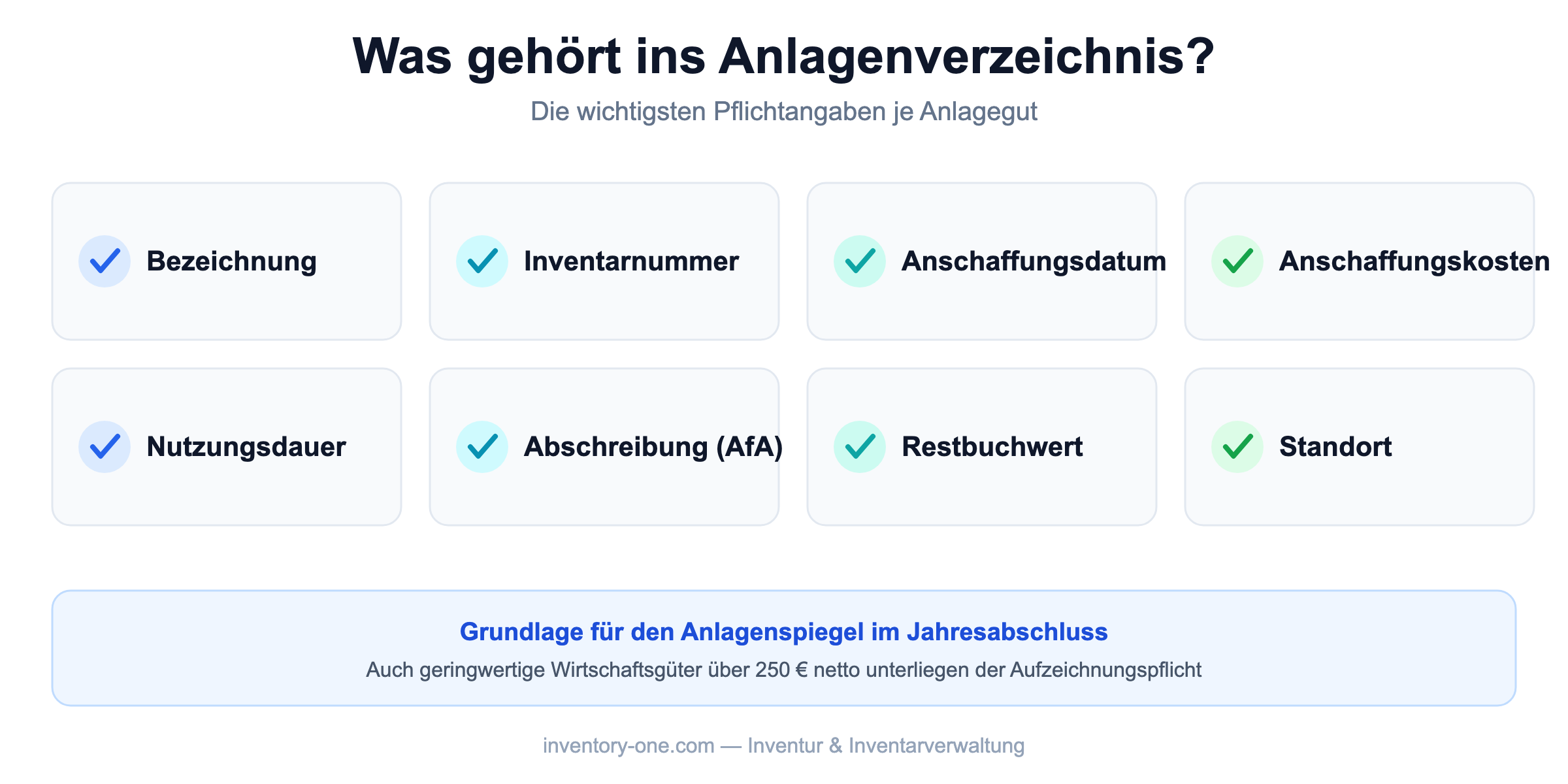
The following information is recorded for each item:
The fixed assets register is a detailed itemized list of the Statement of Changes in Fixed Assets The condensed overview in the annual financial statements. The statement of changes in fixed assets shows the changes in fixed assets over the course of the year—from acquisition cost through additions and disposals to the remaining book value. Without a well-maintained fixed-asset register, the statement of changes in fixed assets cannot be prepared correctly.
Even low-value assets with a net value of more than €250 are subject to the record-keeping requirement and—depending on how they are treated—must be included in the inventory or in the documentation for collective items. For more information, see our articles on low-value assets and the low-value asset threshold.
An asset inventory in Excel quickly becomes outdated: changes in location, disposals, and new acquisitions are often not updated in a timely manner—and when the next inventory is taken, the search begins.
With a digital inventory and asset management system such as Inventory ONE Record each asset using Inventory number, acquisition cost, location, and useful life – by scanning a barcode or QR code. Here's how to List of Low-Value Assets and Fixed Assets Automatically and always exam-proof. Learn more on our pages about Inventory management and to the Inventory system.
A detailed list of all depreciable fixed assets, including acquisition dates, useful lives, depreciation, and net book value. It serves as the basis for the statement of changes in fixed assets.
Among other things, the description, inventory number, date and cost of acquisition, useful life, depreciation, net book value, and location of each fixed asset.
Companies that prepare financial statements, as well as—for the purpose of documenting depreciation—those that use the cash-basis method and have depreciable fixed assets.
The fixed assets register is a detailed list of all fixed assets, while the fixed assets statement is a condensed overview of their changes in the annual financial statements.
This article is intended for general informational purposes only and is not a substitute for tax advice. The value limits mentioned are current as of 2026; the applicable tax regulations at the time are authoritative. Please consult your tax advisor regarding your specific situation.
This post is part of our series on low-value assets and the recording of fixed assets:
About 10,000 satisfied users Trust in Inventory ONE