


The Inventory Turnover Rate shows how often inventory is completely sold and replenished within a given period. It is one of the most important inventory metrics. This article explains the formula, provides an example, and shows how you can improve this metric.
The Inventory Turnover Rate (also known as inventory turnover) indicates how often the average inventory is used up and replenished over a specific period—usually one year. It is a measure of inventory management efficiency: The higher the turnover, the less capital is tied up in inventory.
Inventory Turnover Rate = Cost of Goods Sold ÷ Average Inventory
The average inventory level In simple terms, it is calculated as (beginning inventory + ending inventory) ÷ 2. In some cases, sales revenue is used instead of the cost of goods sold—the important thing is that the numerator and denominator are consistent with each other (both at purchase prices or both at selling prices).
The annual cost of goods sold is 240.000 €, the average inventory level 40.000 €.
Inventory turnover rate = 240,000 ÷ 40,000 = 6. This means the inventory is turned over six times a year.
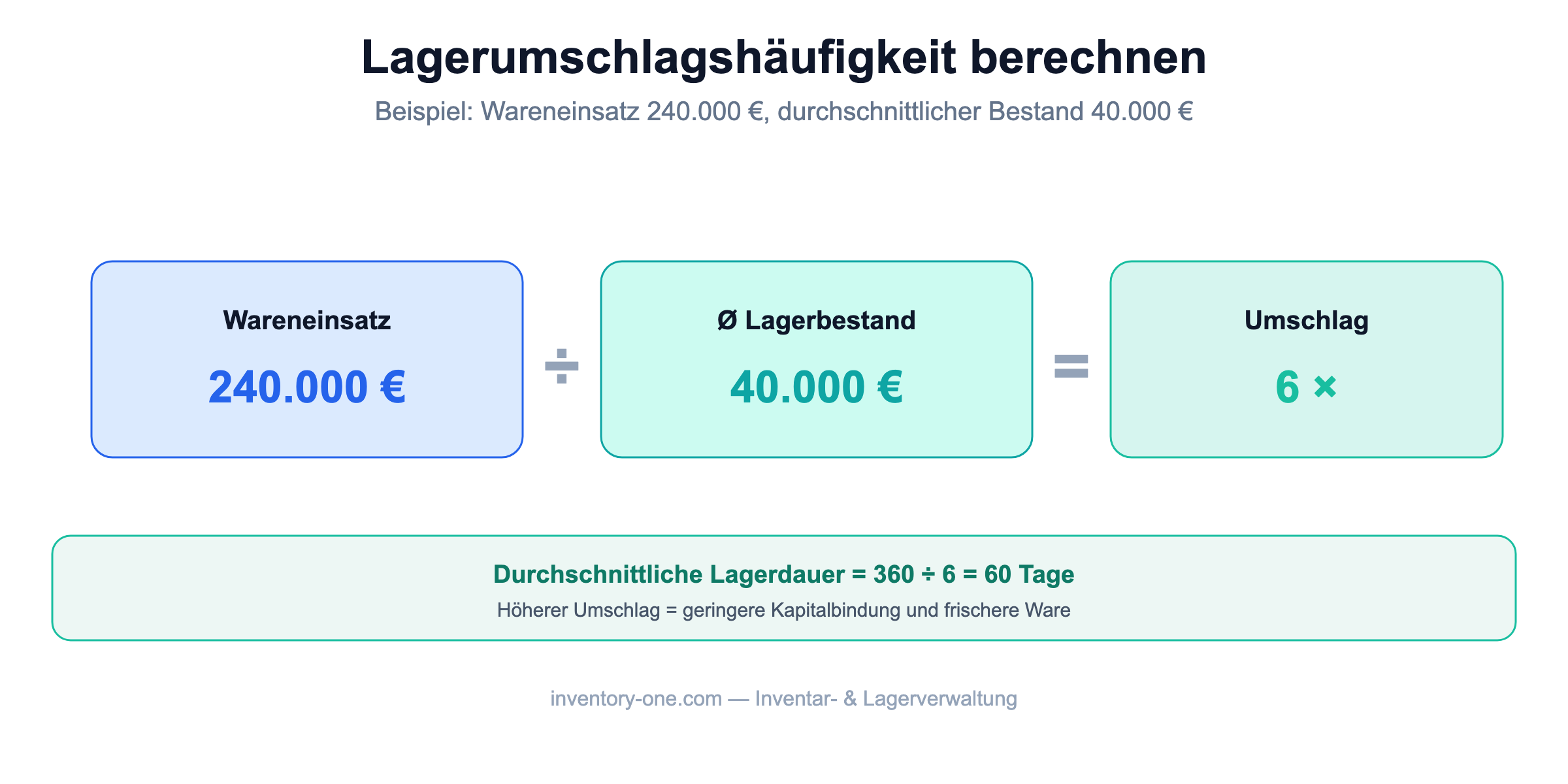
The turnover rate can be used to determine the average storage period Calculate: 360 ÷ turnover rate. In the example, that is 360 ÷ 6 = 60 days. That's the average length of time the merchandise stays in the warehouse.
Manually updating reorder points, minimum stock levels, and inventory turnover rates takes time and is prone to errors. A digital inventory and warehouse management system such as Inventory ONE records every movement via Barcode/QR Code Scan, automatically calculates the key figures and issues a warning as soon as the reorder point is reached. Learn more on our pages about Warehouse management and Inventory Management Software.
How often the average inventory is used up and replenished during a given period. A high value indicates low capital tied up in inventory.
Cost of goods sold divided by the average inventory. The average inventory is calculated simply as (beginning inventory + ending inventory) ÷ 2.
That depends heavily on the industry. As a general rule, the higher the turnover, the better—because less capital is tied up and the goods stay fresher.
Average holding period = 360 ÷ inventory turnover rate. A higher turnover rate means a shorter holding period.
About 10,000 satisfied users Trust in Inventory ONE