


The Minimum inventory – also known as a safety stock or buffer stock – is the minimum level of inventory that should not be allowed to fall below. It acts as a buffer against fluctuations in demand and lead times. This article explains the definition, formula, and provides an example.
The Minimum inventory is the quantity of an item that should always remain in stock as a reserve. It serves as a buffer in case demand unexpectedly increases or a shipment is delayed. That is why it is also referred to as Safety stock or iron reserve.
A common, simple formula is:
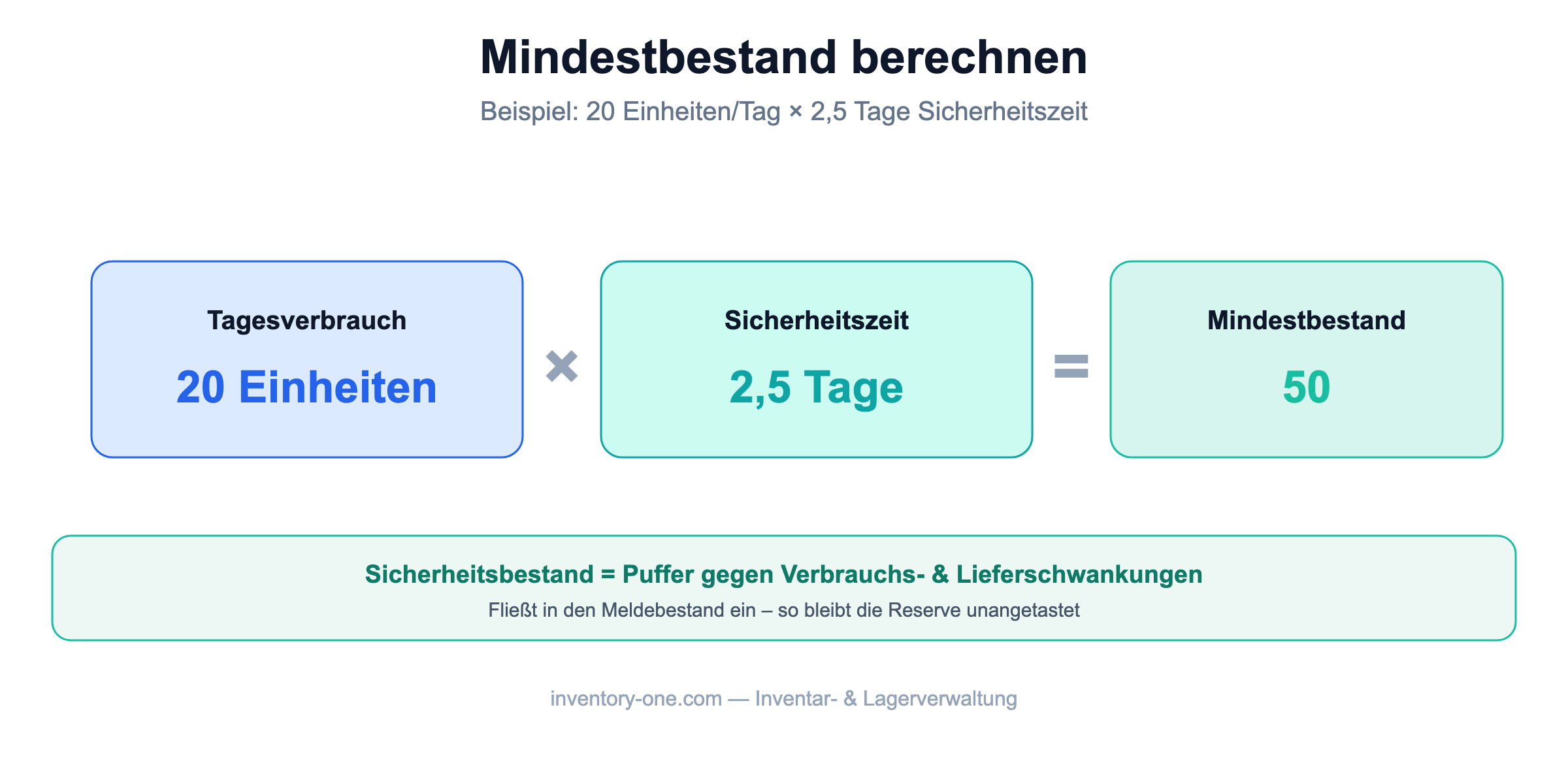
Minimum inventory = average daily consumption × safety factor (in days)
The Safety time is the buffer you factor in addition to the regular lead time. The more uncertain the demand and delivery time, the longer this buffer should be.
With a daily consumption of 20 units and a safety margin of 2.5 days This gives: Minimum balance = 20 × 2.5 = 50 units.
The minimum balance is a component of the Reported inventory: This level is set above the minimum inventory to account for consumption during the replenishment lead time and triggers a reorder in a timely manner. Ideally, this ensures that the minimum inventory is never depleted. To learn exactly how this works, read our article on the reorder point.
Manually updating reorder points, minimum stock levels, and inventory turnover rates takes time and is prone to errors. A digital inventory and warehouse management system such as Inventory ONE records every movement via Barcode/QR Code Scan, automatically calculates the key figures and issues a warning as soon as the reorder point is reached. Learn more on our pages about Warehouse management and Inventory Management Software.
The safety buffer that should always remain in inventory to prevent shortages due to fluctuations in consumption or supply. Also known as safety stock.
A simple formula: average daily consumption × safety margin in days.
The minimum stock level is the reserve; the reorder point is set above that level and triggers a reorder before the reserve is drawn upon.
High enough to reliably cushion against fluctuations, but without tying up capital unnecessarily. The more uncertain the demand and delivery times, the higher it should be.
About 10,000 satisfied users Trust in Inventory ONE