

The Depreciation – for tax purposes Depreciation (AfA) – allocates the acquisition cost of an asset over its useful life. This way, investments do not reduce profits all at once, but rather year by year. This article explains the definition and methods (straight-line, declining-balance, and units-of-production) and provides examples.
Fixed assets lose value over time. The Depreciation reflects this loss in value for accounting purposes: Instead of recognizing the full acquisition or production costs as an expense immediately, they are amortized over the Useful life distributed. In tax terms, this is referred to as the Depreciation (AfA) pursuant to Section 7 of the Income Tax Act (EStG).
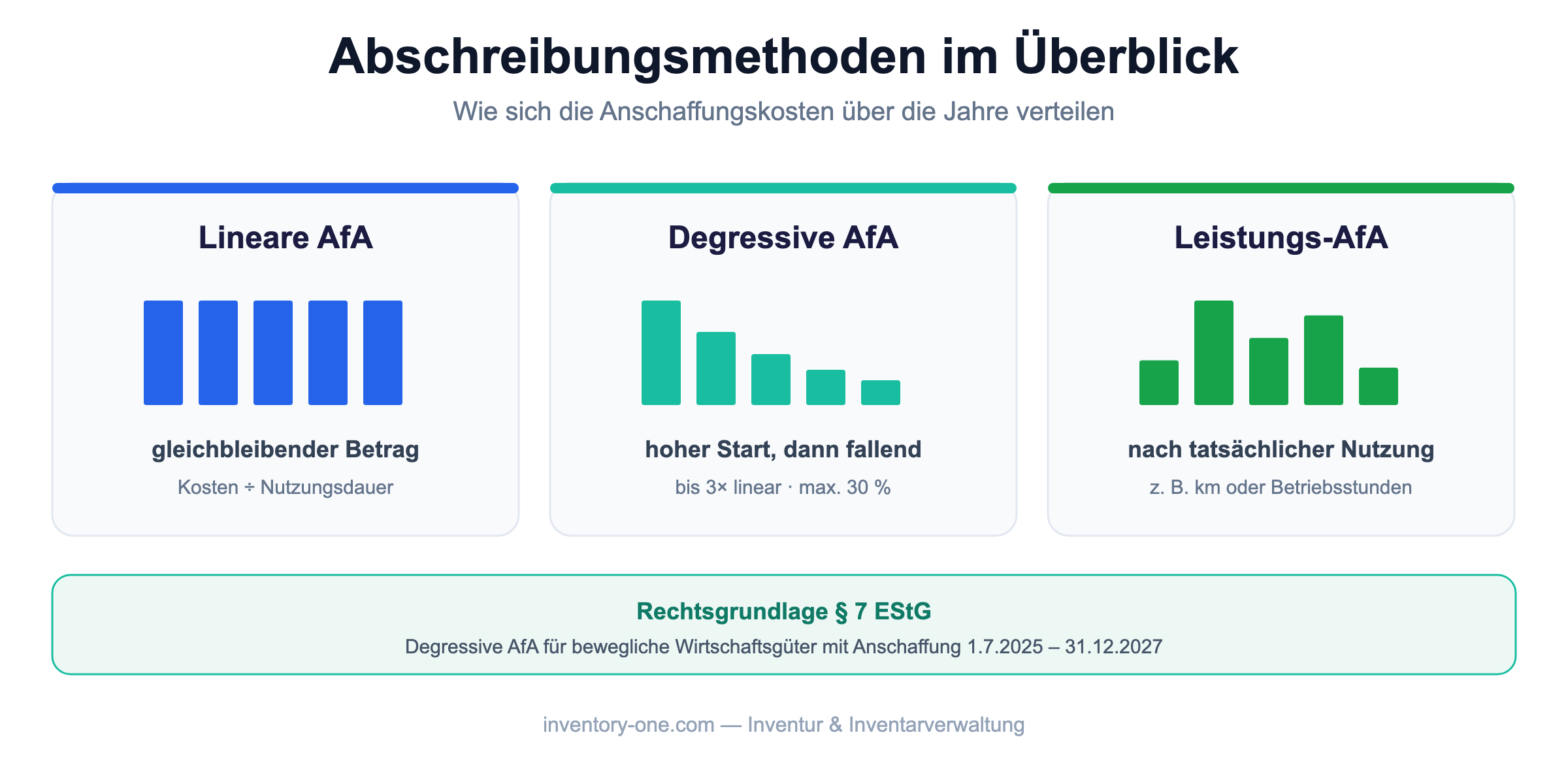
The straight-line depreciation Distributes costs evenly: The same amount is depreciated each year—the acquisition cost divided by the useful life. This is the standard method and is always permissible.
In the declining-balance depreciation A fixed percentage of the respective remaining book value is depreciated—the amounts are high at the beginning and decrease over time. Over the Investment Booster It applies to movable assets that are transferred between the July 1, 2025, and December 31, 2027 purchased again: by Three times the linear depreciation rate, up to a maximum of 30 %. It is advisable to switch to the linear method in a good year.
The Depreciation Based on Output Calculates depreciation based on actual use (e.g., kilometers driven or operating hours). This method is useful when wear and tear varies significantly.
The duration of the depreciation period depends on the normal useful life. You can find this information in the Depreciation Tables from the Federal Ministry of Finance. For more details, see our article on the depreciation table.
Assets with a net value of up to €800 may be fully depreciated immediately. For more information, see our article on low-value assets (GWG).
A machine costs €10,000 net and has a useful life of 5 years. Linear €2,000 is depreciated annually. Decreasing (30 %) The amount is €3,000 in the first year and €2,100 in the second—so it’s significantly higher at the start. You can calculate both step by step in our article on depreciation calculations.
Any depreciation calculation requires that you know which assets you own, how much they cost, and when they were purchased. This is exactly what a well-maintained fixed asset or inventory list provides. With Inventory ONE Record each fixed asset using Cost, Date, and Useful Life via scan—the perfect basis for your depreciation. Learn more on our pages about Inventory Management Software and to the Inventory system.
The allocation of the acquisition or production cost of an asset over its useful life; tax deduction for depreciation under Section 7 of the Income Tax Act (EStG).
In particular, straight-line and declining-balance depreciation, as well as usage-based depreciation. For low-value assets, there is also immediate write-off.
Yes. For tangible assets acquired between July 1, 2025, and December 31, 2027, declining-balance depreciation of up to 3× the straight-line depreciation rate, with a maximum of 30 %, is permitted.
Based on the standard useful life specified in the depreciation tables of the Federal Ministry of Finance.
This article is intended for general informational purposes only and is not a substitute for tax advice. The regulations mentioned are current as of 2026; the applicable tax regulations in effect at any given time shall prevail. Please consult your tax advisor regarding your specific situation.
About 10,000 satisfied users Trust in Inventory ONE