

The Depreciation Schedule It specifies the standard useful life for nearly every asset—and thus determines the number of years over which you can depreciate it. This article explains what the depreciation table is, what types exist, and how to find the correct useful life.
The Depreciation Schedule is an official directory in which the Federal Ministry of Finance lists economic assets normal useful life specifies. This useful life serves as the basis for straight-line depreciation: acquisition cost divided by useful life yields the annual depreciation amount. Although the tables do not have the force of law, they are recognized by the tax authorities as a guideline.
| Economic asset | Service Life (Approximate) |
|---|---|
| Computer, Laptop, Software | 1 year (since 2021) |
| Passenger Cars | 6 years |
| Office furniture (e.g., desk) | 13 years |
| Truck / Commercial Vehicle | 9 years |
| Tools (General) | Depending on the species, often 3–8 years |
Please always refer to the current depreciation table for the exact values; industry-specific assets may vary.
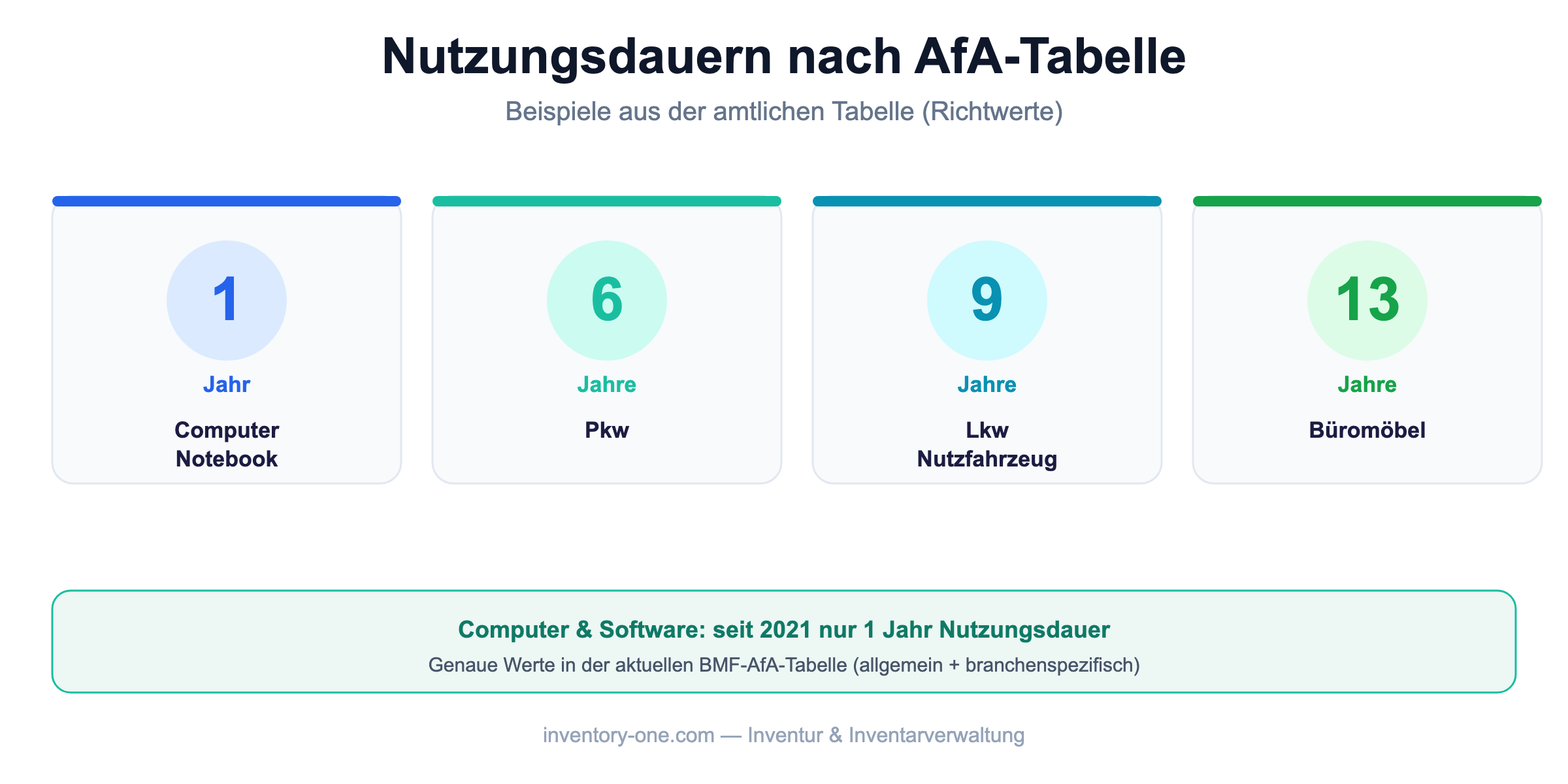
Since 2021, the tax authorities have allowed a useful life of one year for computer hardware and software. This means that these assets can be fully depreciated in the year of acquisition.
Any depreciation calculation requires that you know which assets you own, how much they cost, and when they were purchased. This is exactly what a well-maintained fixed asset or inventory list provides. With Inventory ONE Record each fixed asset using Cost, Date, and Useful Life via scan—the perfect basis for your depreciation. Learn more on our pages about Inventory Management Software and to the Inventory system.
An official directory published by the Federal Ministry of Finance that specifies the standard useful life of assets—the basis for depreciation.
It does not have the force of law, but is recognized by the tax authorities as a guideline and is applied in practice.
Since 2021, a useful life of one year may be applied to computer hardware and software.
In the general depreciation table (AV) or in the relevant industry-specific table published by the Federal Ministry of Finance.
This article is intended for general informational purposes only and is not a substitute for tax advice. The regulations mentioned are current as of 2026; the applicable tax regulations in effect at any given time shall prevail. Please consult your tax advisor regarding your specific situation.
About 10,000 satisfied users Trust in Inventory ONE